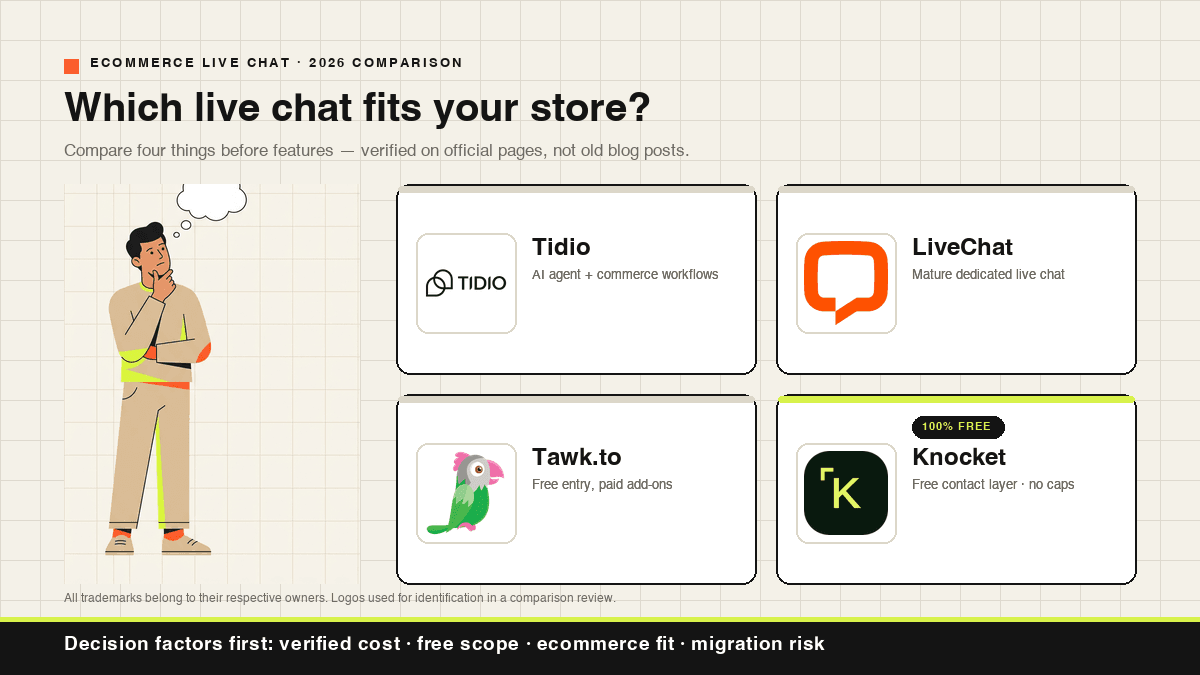

TL;DR: If you are choosing an ecommerce live chat tool in 2026, compare four things before features: verified monthly cost, what the free scope actually includes, how well the tool fits shopping-cart and order questions, and how painful it will be to migrate later.
2026 Comparison Table: Tidio, LiveChat, Tawk.to, and Knocket
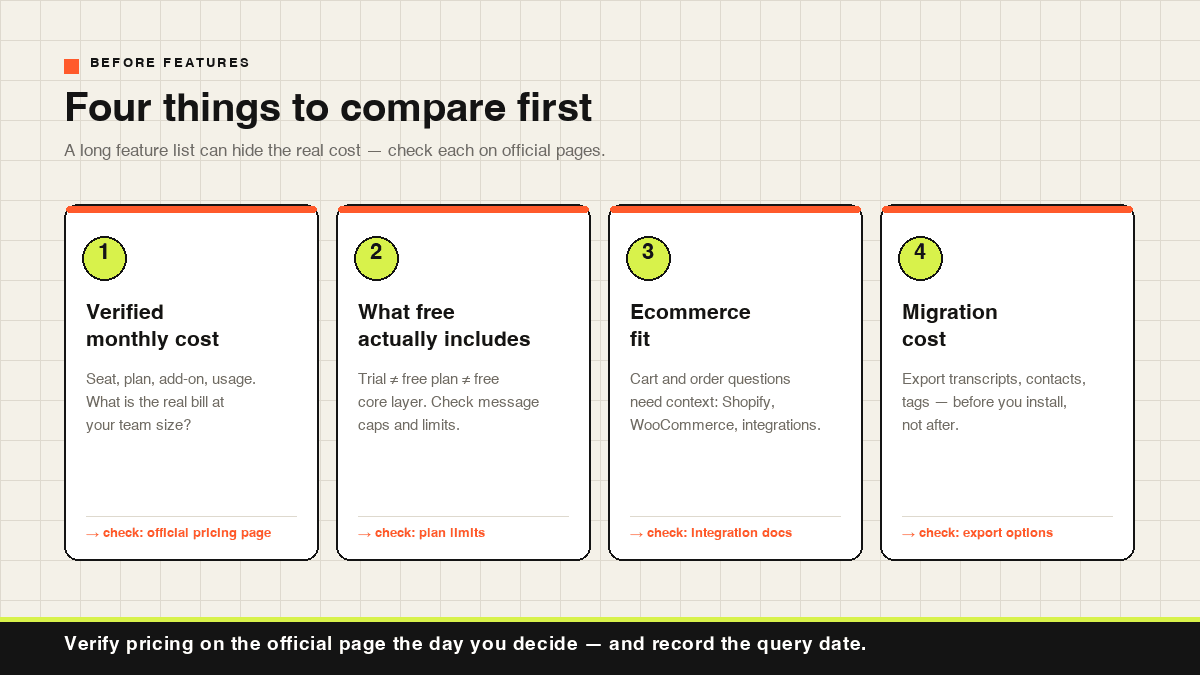
Because live pricing pages were not available for verification while drafting this article, competitor prices below are not quoted as current facts. Before publishing or making a purchase decision, check each vendor’s official pricing page on the same day and record the query date. Knocket facts in this article use the supplied Knocket product knowledge base.
| Decision factor | Tidio | LiveChat | Tawk.to | Knocket |
|---|---|---|---|---|
| Pricing | Must be verified on Tidio’s official pricing page before publication | Must be verified on LiveChat’s official pricing page before publication | Must be verified on Tawk.to’s official pricing page before publication | 100% free · no card · forever |
| Free scope / free allowance | Not live-verified in this draft; check official limits before purchase | Not live-verified in this draft; check official trial/free details before purchase | Not live-verified in this draft; check official free-scope details before purchase | Core contact experience is free; no message caps |
| Best-fit scale | Stores comparing chat, automation, and ecommerce workflows; verify plan gates | Stores that want a mature dedicated live-chat product and can budget for paid support tooling | Budget-sensitive stores that want live chat with a low entry cost; verify add-ons and operational fit | Indie stores, creators, service providers, early teams, and small ecommerce operators that need a free contact layer |
| Visitor entry points | Website chat; verify ecommerce integrations and current plan limits | Website chat; verify ecommerce integrations and current plan limits | Website chat; verify current marketplace/integration options | Web Widget, Contact Page, Mobile Widget |
| Inbox model | Verify current inbox, agent, and channel behavior | Verify current inbox, agent, and channel behavior | Verify current inbox, agent, and channel behavior | Web Widget, Mobile Widget, Telegram, and Email into one unified Inbox |
| Ecommerce fit | Likely strongest if you need commerce-oriented workflows; verify official feature list | Likely strongest if you need structured live-chat operations; verify official feature list | Likely attractive if cost is the main constraint; verify operational tradeoffs | Strong for lightweight pre-sale and post-sale contact; not a full ecommerce helpdesk |
| Migration risk | Export, contacts, automations, and integrations need review | Export, transcripts, reports, and team workflows need review | Export, agent workflow, and add-on dependency need review | Lightweight setup; migration out still requires preserving conversation context manually or through available exports |
Official pages to verify before publishing: Tidio pricing, LiveChat pricing, and Tawk.to pricing. For broader ecommerce customer-service context, see Baymard’s checkout research on form and checkout friction, Shopify’s ecommerce support resources, and Grand View Research’s customer experience management market coverage.
Selection Criteria: What Ecommerce Store Owners Should Compare First
For ecommerce, “best live chat” is not a generic feature contest. A store owner usually needs answers to specific operational questions:
- Can visitors ask before buying? Product sizing, shipping time, discount codes, payment methods, and stock questions often appear before checkout.
- Can customers ask after buying? Order status, address changes, delivery exceptions, return windows, and invoice questions are post-purchase workflows. These usually need order context from Shopify, WooCommerce, or another commerce stack.
- What happens when you are offline? A small store may not have agents online all day. Offline forms, email capture, and mobile replies can matter more than advanced dashboards.
- What is the real cost at your team size? Some tools charge by seat, plan, add-on, or usage. Do not compare only the headline price.
- Can you leave later? Live chat becomes part of customer history. If you cannot export transcripts, contacts, or tags cleanly, the low-cost option may become expensive during migration.
For Knocket-specific setup, start with the Knocket installation guide, manage conversations in the Knocket unified Inbox, and use the mobile H5 Inbox when you need to reply from a phone browser.
Tidio: Pricing Model, Free Scope, and Best-Fit Scale
Official pricing query date for this draft: not completed. Live SERP and live pricing evidence were unavailable during drafting, so no current Tidio price or free allowance is quoted here.
Tidio is commonly evaluated by ecommerce stores because it combines live chat with commerce-oriented customer interaction features. For a store owner, the important question is not only “Does Tidio have chat?” but “Which plan includes the exact workflows my store needs?”
Before choosing Tidio, verify these items directly on Tidio’s official pricing and product pages:
| Item to verify | Why it matters for ecommerce |
|---|---|
| Monthly plan price | Determines whether the tool still fits after your store adds agents or features |
| Free allowance | Free chat may be enough for testing, but limits can affect real operations |
| Conversation or visitor limits | A promotion, influencer post, or holiday campaign can spike volume |
| Ecommerce integrations | Shopify, WooCommerce, and order-context integrations should be checked on the current official page |
| Automation and routing | Useful only if included in the plan you intend to buy |
| Data export | Required if you later migrate conversations or customer context |
Tidio may be a good fit if your store wants a product that is already oriented toward ecommerce support and you are willing to validate pricing carefully. It is less ideal if your only requirement is a free, lightweight contact layer with no message caps.
LiveChat: Pricing Model, Free Scope, and Best-Fit Scale
Official pricing query date for this draft: not completed. Live evidence was unavailable, so current LiveChat pricing, trial terms, and free allowance are not quoted.
LiveChat is typically considered by stores that want a dedicated live-chat product rather than a minimal widget. The likely buyer is a store with clearer support workflows: multiple people answering customers, expectations around response time, and a need for reporting or structured operations.
Before selecting LiveChat, verify these official details:
| Item to verify | Why it matters |
|---|---|
| Price per plan and billing period | Annual and monthly billing can change the real cost |
| Seat or agent pricing | Support teams often grow one person at a time |
| Trial or free availability | A trial is not the same as a permanent free scope |
| Chat history retention | Important for disputes, returns, and repeat buyers |
| Integration depth | Check whether order lookup, CRM, or helpdesk workflows need another product |
| Export formats | Needed for migration and compliance review |
LiveChat can make sense for growing stores that treat support as a formal team function. The tradeoff is budget and process overhead: a mature live-chat tool can be more than a solo store needs if the owner mainly wants to answer pre-sale questions quickly.
Tawk.to: Pricing Model, Free Scope, and Best-Fit Scale
Official pricing query date for this draft: not completed. Current Tawk.to pricing, free scope, add-ons, and limits were not live-verified.
Tawk.to is often placed on ecommerce shortlists because store owners associate it with low-cost live chat. That makes it especially attractive for new stores, dropshipping tests, service businesses with a storefront, and merchants that want to avoid a monthly software bill early on.
However, a free or low-cost entry point does not remove the need for operational checks. Verify:
| Item to verify | Why it matters |
|---|---|
| Current free scope | Confirm what is included without paid add-ons |
| Branding, add-ons, and optional services | Low entry cost may still include paid operational choices |
| Agent workflow | Confirm how multiple responders coordinate |
| Mobile reply experience | Owners often answer from a phone, not a desktop dashboard |
| Export options | Needed if you outgrow the tool |
| Ecommerce platform support | Confirm Shopify, WordPress, or custom-site setup from official docs |
Tawk.to can be a reasonable candidate when budget is the main constraint and the team is comfortable checking add-ons and workflow fit. It may require more process discipline as order volume and support complexity grow.
Knocket: 100% Free · No Card · Forever, and No Message Caps
Knocket is positioned differently from a traditional paid live-chat suite. It is a lightweight customer contact platform for indie developers, early-stage founders, creators, service providers, and small teams. For ecommerce, that means it is best viewed as a free contact layer rather than a full enterprise customer-service system.
Knocket’s confirmed pricing statement is:
100% free · no card · forever
Knocket also has no message caps according to the supplied product facts.
Its core contact surfaces are:
- Web Widget: a website live-chat entry installed with one script tag copied from the console.
- Contact Page: a shareable page at a handle-style URL such as
knocket.io/your-handle, suitable for an X bio, GitHub README, email signature, business card QR code, or simple “contact us” destination. - Mobile Widget: an app-side contact entry for iOS, Android, React Native, and Flutter through a WebView-style integration.
- Unified Inbox: Web Widget, Mobile Widget, Telegram, and Email messages are handled in one place with shared conversation history.
For ecommerce owners, the practical value is simple: if you need a free way for visitors to ask questions from a store page, a mobile app, Telegram, Email, or a public contact link, Knocket reduces the first setup and pricing barrier. Telegram setup is designed to be quick, and in Full and quote reply mode, replying in Telegram can send the answer back to the visitor’s original screen.
Useful Knocket links:
- Install the Web Widget
- Open the unified Inbox
- Use the mobile H5 Inbox
- Manage your Contact Page
- Install the WordPress plugin
- Use the Framer plugin
Knocket is powered by Tencent RTC infrastructure, but it should not be described as a generic Tencent RTC SDK or a full CRM.
Ecommerce Fit: Cart Questions, Order Inquiries, and Offline Hours
Shopping-cart questions
For cart-stage support, speed matters. Common questions include:
- “Will this arrive before Friday?”
- “Does this size run small?”
- “Can I use two discount codes?”
- “Is this item compatible with the product I already bought?”
Tidio, LiveChat, and Tawk.to should be evaluated based on their current ecommerce integrations, visitor context, and routing options. Do not assume every plan includes the same commerce features.
Knocket fits cart questions when the goal is to add a direct contact point to a product page, landing page, Shopify storefront, WordPress store, React app, or plain HTML site. It is especially relevant when the owner or small team wants all visitor messages in one Inbox without adding a paid live-chat subscription.
Order inquiries
Order inquiries are more sensitive than pre-sale chat because customers expect account-specific answers. A chat tool is only one part of the workflow. You may also need:
- order lookup in Shopify, WooCommerce, or your backend;
- refund and return policy access;
- shipping carrier information;
- identity verification;
- internal notes.
If your support team needs deep order lookup inside the support tool itself, verify each vendor’s ecommerce integration depth before buying. Knocket can collect and centralize the customer conversation, but it should not be treated as an order-management system.
Offline hours
For small ecommerce teams, offline handling is often the deciding feature.
Knocket supports offline information collection. The Web Widget can collect fields such as Name, Email, Phone Number, and Message depending on configuration, with modes including Off, Before conversation, and When Offline. That means a visitor can leave an email and context when the store owner is not available.
For Tidio, LiveChat, and Tawk.to, verify the current offline form behavior, email capture, retention, and notification settings from official docs before committing.
Installation and Integration Cost: WordPress, Shopify, React, Plain HTML, and Mobile
Implementation cost is not just developer time. It includes theme access, app-store permissions, testing, and future maintenance.
| Platform | What to check | Knocket path |
|---|---|---|
| WordPress | Plugin availability, theme footer injection, cache behavior | WordPress plugin or script installation |
| Shopify | Theme code access, app compatibility, checkout restrictions | Add the script to a theme-level template where custom code is allowed |
| React / Astro / Vue / Next.js | Shared layout placement, hydration issues, route changes | Add the async script from the console to the common layout |
| Plain HTML | Ability to edit pages or shared footer | Paste the script before the closing body tag |
| iOS / Android | Whether support is website-only or app-side | Use Mobile Widget through WebView |
| React Native / Flutter | WebView package and close-event handling | Use the Mobile Widget URL and platform instructions from the console |
Knocket’s web embed is one line, copied from the console, in the form of an async script source such as https://trtc.io/knocket-sdk/sdk.js?identifier=.... Use the actual identifier from the Knocket console, not a manually invented URL.
For competing tools, check whether you are installing an app, a plugin, a script, or a deeper ecommerce integration. A script-only install is usually faster; a deep order integration may take longer but can reduce agent workload later.
Migration Cost and Data Export: Conversation History, Contacts, Workflows, and Risk Checklist
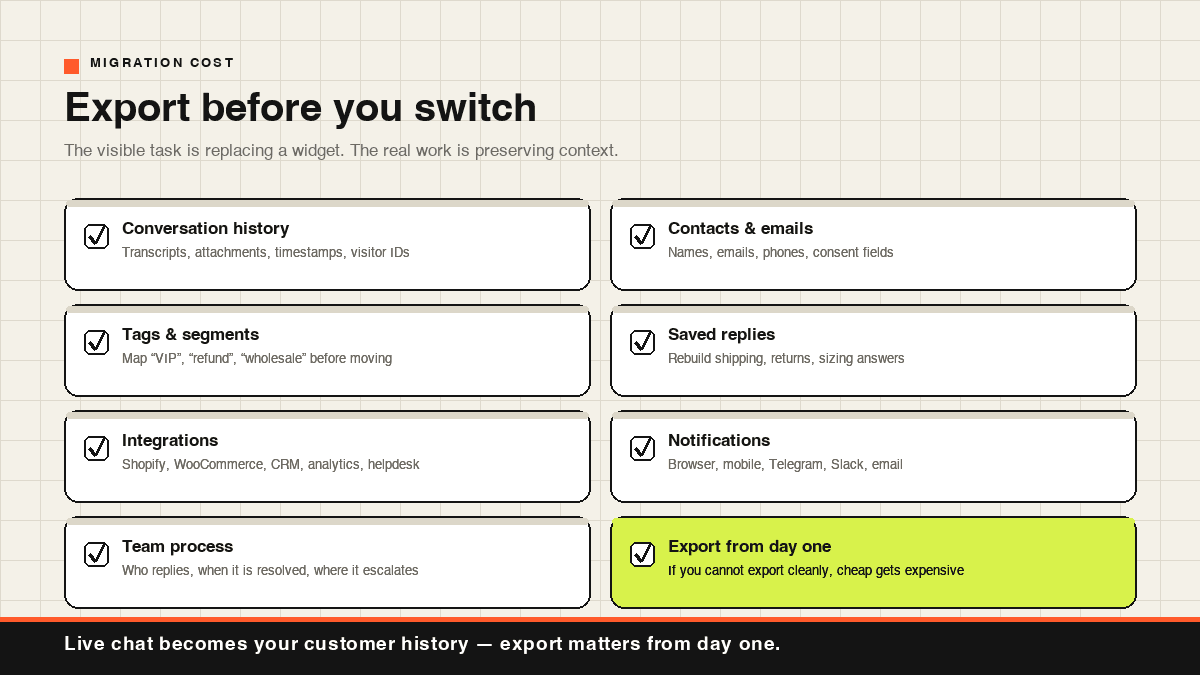
Live chat migration is usually underestimated. The visible task is replacing a widget. The real work is preserving context.
Before switching tools, document:
- Conversation history Can you export transcripts? Are attachments included? Are timestamps, visitor IDs, and page URLs preserved?
- Contacts and emails Can you export names, emails, phone numbers, and consent-related fields?
- Tags and segments If your old tool uses tags such as “VIP,” “refund,” or “wholesale,” map them before migration.
- Saved replies and macros Rebuild the answers your team uses for shipping, returns, sizing, and payment issues.
- Integrations List Shopify, WooCommerce, email, analytics, CRM, helpdesk, and warehouse tools.
- Notifications Recreate browser, mobile, Telegram, Slack, or email notification workflows only after confirming what the new tool supports.
- Team process Define who replies, when conversations are considered resolved, and where escalations happen.
Knocket is lightweight, so the setup side is simple. But migration still requires care: if you are leaving another tool, export your old conversations before removing the old widget. If you are leaving Knocket later, plan how you will preserve Inbox history and customer context based on the export options available at that time.
Free vs Paid Tools: Budget, Scale, Response Time, and Operational Complexity
A free live chat tool is not automatically better for a store, and a paid tool is not automatically overkill. The right choice depends on what creates cost in your business.
Choose a free or lightweight tool when:
- you are still validating the store;
- one owner or a small team answers most questions;
- chat volume is manageable;
- you mainly need contact capture and direct replies;
- you want to avoid message caps and card-based signup friction.
Choose a paid or more structured tool when:
- multiple agents work in shifts;
- you need reporting for response time and workload;
- support has to integrate with order management;
- supervisors need assignment, permissions, and quality review;
- customer-service operations are part of a larger support organization.
For independent stores, Knocket’s appeal is its cost structure: 100% free · no card · forever, with no message caps. For larger support operations, price is only one variable; governance, reporting, permissions, and integration depth may matter more.
Recommendations by Team Size: Solo Owners, Small Teams, Growing Stores, and Support Teams
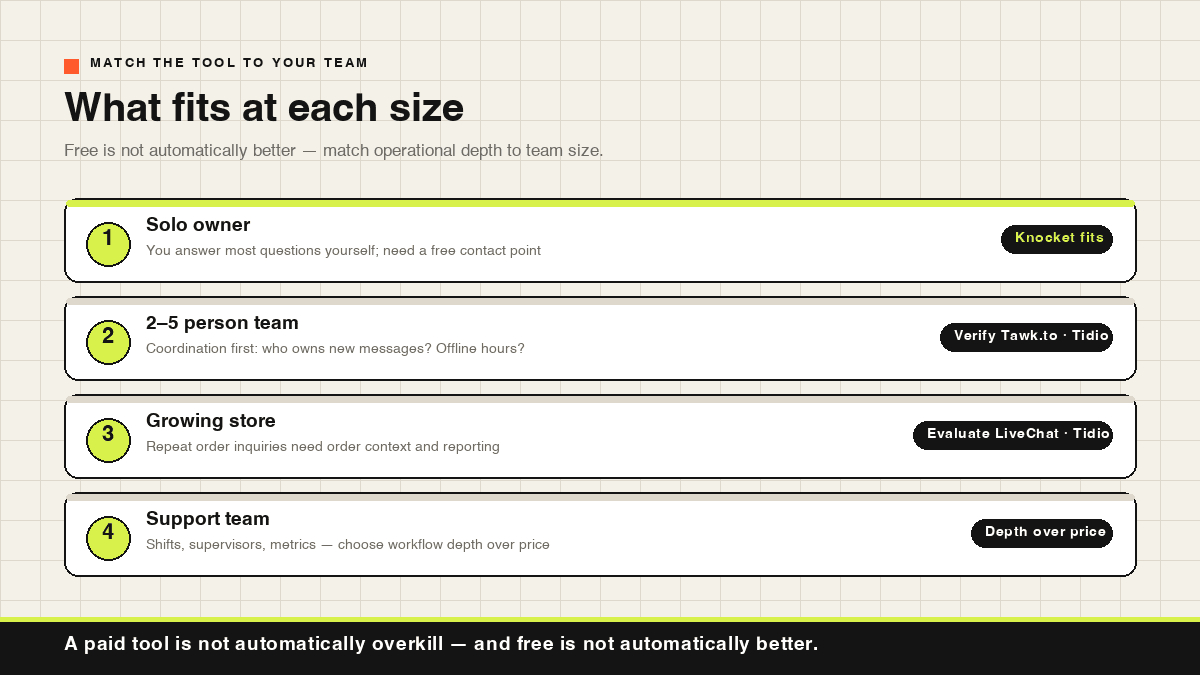
Solo ecommerce owner
Start with the tool that creates the least operational drag. If you mostly answer questions yourself and need a free website contact point, Knocket is a strong candidate. The Web Widget, Contact Page, Telegram, Email, and unified Inbox model fit a solo workflow well.
Also evaluate Tawk.to if you want another free-oriented option, but verify the current free scope and any add-ons before relying on it.
Two-to-five-person ecommerce team
For a small team, the key question is coordination. Who owns new messages? How do you avoid two people replying at once? How do you handle offline hours?
Knocket can work if the team’s workflow is still simple and shared Inbox visibility is enough. Tidio or LiveChat may be worth evaluating if your team needs more structured ecommerce workflows, routing, or reporting. Verify current plan gates before deciding.
Growing store with repeat order inquiries
If many chats are post-purchase questions, prioritize order context. A tool that can show order status, customer history, or integration context may save more money than it costs.
In this case, LiveChat or Tidio may deserve deeper evaluation, depending on their current ecommerce integrations and pricing. Knocket can still serve as a lightweight contact layer, but it should not be treated as a full order-support console.
Dedicated customer support team
If you have scheduled agents, supervisors, performance metrics, and internal escalation rules, choose based on workflow depth rather than headline price.
LiveChat may be closer to this buying motion, but verify current pricing, seat model, and reporting. Tidio may also fit if its current ecommerce and automation features match your process. Knocket is more appropriate as a lightweight contact layer for small teams than as a complete enterprise support suite.
Where Knocket Is Not a Fit
Knocket is not the right choice for every ecommerce store. Be especially cautious if you need:
- Complex team-seat management: If your selection process depends on advanced roles, permissions, departments, or workforce management, verify other tools built for larger support teams.
- Deep enterprise helpdesk workflows: Knocket should not be treated as a full ticketing, SLA, QA, or CRM suite.
- Native order-management inside the support tool: Knocket can centralize conversations, but it does not replace Shopify, WooCommerce, ERP, or fulfillment systems.
- A purchasing decision based mainly on AI automation: This article does not evaluate AI automation features for any vendor. If automated answering is a core requirement, run a separate test using each vendor’s current official documentation and pricing.
- Custom-domain or enterprise procurement requirements: Do not assume custom domain, procurement controls, or enterprise admin features are available unless confirmed in the current product documentation.
The honest positioning: Knocket is a free contact layer for makers and small teams that want visitors to reach them from web, mobile, Telegram, Email, or a simple link. It is not a replacement for every support operations tool.
Final Decision: How to Choose by Price, Free Scope, Store Size, and Migration Cost
Use this decision sequence:
- Verify pricing on the official page the day you decide. For Tidio, LiveChat, and Tawk.to, record the official pricing page URL and query date. Do not rely on old comparison posts.
- Define your support workload. Separate pre-sale cart questions from post-purchase order inquiries. They require different tooling depth.
- Check the free scope honestly. Free trials, free plans, free tools, and free core contact layers are not the same thing.
- Estimate migration cost before installing. If the tool becomes your customer-history store, export matters from day one.
- Match the tool to your team size. Solo and small teams usually need fast setup and low cost. Growing teams need routing, reporting, and integration depth.
If you want the lowest-friction starting point, Knocket is the clearest price case in this comparison: 100% free · no card · forever, with no message caps, a Web Widget, Contact Page, Mobile Widget, Telegram and Email ingestion, and one unified Inbox. If you need a more mature paid support operation, verify Tidio, LiveChat, and Tawk.to against your exact ecommerce workflow before committing.
FAQ
Is this a current 2026 pricing comparison?
It is a 2026 selection guide, but competitor prices were not live-verified during drafting. Before publishing or buying, check Tidio, LiveChat, and Tawk.to official pricing pages and record the query date.
Which tool is best for a solo ecommerce owner?
If the priority is a free contact layer with no message caps, Knocket is a strong fit. If you want to compare other free-oriented options, verify Tawk.to’s current free scope and add-ons.
Which tool is best for a growing ecommerce support team?
A growing team should evaluate workflow depth, reporting, routing, integrations, and export options. LiveChat and Tidio may be relevant candidates, but current plan details must be verified from official pages.
Can Knocket handle Shopify or WordPress stores?
Knocket supports WordPress, Shopify, React, and plain HTML through script or plugin-based installation paths. WordPress also has a Knocket plugin. Shopify setup depends on where your theme allows custom scripts.
Does Knocket have message caps?
According to the supplied Knocket product facts, Knocket has no message caps and is priced as 100% free · no card · forever.
Can I reply to ecommerce visitors from Telegram with Knocket?
Yes, after Telegram is configured. In Full and quote reply mode, replying by quoted message in Telegram can send the response back to the visitor’s original screen. High-volume forwarding can be affected by Telegram rate limits, so test your workflow.
What should I export before switching live chat tools?
Export conversation transcripts, contacts, email addresses, tags, saved replies, reports, and integration settings where available. Also document team workflows before removing the old widget.
Is Knocket a full helpdesk or CRM?
No. Knocket is a lightweight customer contact platform with Web Widget, Contact Page, Mobile Widget, and a unified Inbox. It should not be positioned as a full enterprise helpdesk, ticketing system, or CRM.
Try Knocket as your free ecommerce contact layer at https://knocket.ai/.